
Sources Behind Belleville Previous Residents
Build the backward trail from sources that state different facts. The parcel and deed records connect a legal description and recorded parties. Directories and newspapers supply dated occupancy leads. Census schedules add a household layer, while maps can test whether the structure or street layout fits the period. Older material is not all online, so the source, custody, and access method matter as much as the year. The table separates the web index from books, microfilm, and office records rather than promising one continuous search.
| Source | Years It Covers | Where Held | What It Shows |
|---|---|---|---|
| Essex PRESS computer index | 10/01/1996-present | Essex Register portal and office | Grantor, grantee, instrument, and date-limited search |
| Essex deed and mortgage books | Recorded material claimed since 1637 | Essex Register, Record Room, and Public Vault | Legal instruments and historical title evidence |
| Belleville directories | 1921-1972 | Belleville DigiFind-It | Dated occupants, businesses, and address entries |
| Federal census | 1870 catalog includes Belleville; public through 1950 | FamilySearch and federal census sources | Enumerated household and locality information |
| Sanborn maps | 1938-1950 publication range | Library of Congress | Building footprint, use, and street continuity |
When the date is recent, begin with the parcel and PRESS. When it is older, take the address, block and lot, legal description, and approximate year to the Record Room, library, archives, or repository that holds the right medium. A directory entry can name a past occupant, but it does not establish ownership. A deed can name a recorded party, but it does not establish every member of a household.
Freeze a Belleville Parcel Before Going Back
Begin with the current street address through the Belleville Tax Assessor or the Essex County Tax Board route. Copy the municipality, block, lot, legal description, assessed owner, mailing address, tax year, and any PAMS or GIS PIN shown. The situs address is the parcel location. A mailing address is a separate clue and may be outside Belleville. State GIS material is useful for geometry and parcel identifiers, but state-hosted owner names can be suppressed under Daniel's Law.
Save the date of the search with every field. This first row is the control point for a trail of past residents because street numbers can change, names can be abbreviated, and trusts or estates can appear in recorded documents. Do not fill an unavailable owner field with an assumption. Ask the local custodian whether the specific field is public, then use the block and lot or legal description to continue through the register records.
Note: The exact Belleville parcel-result labels were not captured in the research, so record only fields actually returned by the official source.
Walk Belleville Previous Residents Through Deeds
The Essex PRESS index supports searches by municipality, block and lot, name, document type, instrument number, book and page, and date. Choose BELLEVILLE, then start with the current or most recent deed. Capture the grantor, grantee, recording date, document type, instrument number or book and page, and any image or copy availability. Search the seller from that deed as a grantee to locate the earlier purchase, then repeat the sequence backward.
- Copy the current parcel fields and search date from the assessor or Tax Board result.
- Search PRESS by BELLEVILLE and block and lot, or use the known party name and a document date.
- Open the most relevant deed and write down both parties, recording details, and the legal description.
- Search that deed's grantor as a grantee to find the earlier transaction, preserving alternate spellings, trusts, corporations, or estate wording.
- Use DEED first, then review mortgages, discharges, liens, or other instruments only as context. Move to the Record Room when the online index stops.
- Grantor
- The party transferring an interest in the recorded instrument.
- Grantee
- The party receiving that recorded interest. In a backward chain, a later grantor is often searched as an earlier grantee.
- Chain of title
- A sequence of recorded transfers that links legal interests in a parcel. It is not a list of everyone who lived there.
- Legal description
- The parcel wording used in a recorded instrument. It can connect older records when a street address is unclear or has changed.
Party roles need to stay attached to the date and instrument. A recorded seller, buyer, estate, lender, or attorney-in-fact is not automatically a resident. Note the role as it appears, then use a directory, census, newspaper, or another address source when the question is who lived at the property.
Belleville Previous Residents and PRESS Limits
The key split is medium, not just date. PRESS says its computer index begins 10/01/1996 and permits no more than a 90-day date range. Long searches should be divided into successive 90-day windows. Register materials describe electronic transactions and images from 05/01/2001, but remote index access does not guarantee that every image or certified copy is available without the office. Older deeds and books require Record Room, Public Vault, or other office research.
Essex reports 17,741 books and says deeds and mortgages have been filed since 1637. That is a statement about holdings, not a claim that 1637 material can be searched from home. The Record Room is open weekdays from 8:30 a.m. to 4:30 p.m. Staff can explain the index, books, and computers, but they do not conduct a title search. A certified deed or mortgage copy costs $8 for the first page and $2 for each additional page.
Belleville Directory Checkpoints by Address
Use a dated address entry to test who lived there before, not to replace the deed chain. Belleville's digitized directory collection covers 1921 through 1972, and the street section can run from house number and street toward an occupant or business. The 1894 Baldwin regional directory at the New Jersey Historical Society is an earlier regional lead. Between those points, a gap should remain a gap until a library, archive, or microfilm source supplies an actual date.
Record whether the line identifies an occupant, a business, an owner, or only a nearby listing. The same address may carry a different household, business, or street form over time. The historical volumes themselves and their reading conventions are covered on the Belleville city directory page; here, the useful result is one dated checkpoint in an address-by-address trail.
Newark Public Library's regional collection also holds NJ Bell telephone books on microfilm for 1908 through 1990. A telephone listing is an address lead and can omit unlisted subscribers, so it needs corroboration from another source.
Belleville Census and Map Checkpoints
Pair the closest directory year with a public census year, then add the map layer. The FamilySearch catalog identifies Belleville in the 1870 New Jersey 2nd Essex County part, and the current public federal census endpoint in this research is 1950. Census entries can show an enumerated household and locality, but they may not supply a precise modern street number. They should be read as household evidence, not as a duplicate of the directory.
The 1950 Belleville Sanborn item contains 63 sheets and was created or published across 1938 through December 1950. Use its street, footprint, and building-use detail to distinguish a structure from an address line in an old directory. No official town-wide Belleville renumbering or renaming schedule was found. When a number looks wrong, compare the street name, adjacent owner, block and lot, legal description, directory neighbors, and Sanborn footprint rather than assuming the number stayed fixed.
Note: A census household may contain people who do not appear in a directory, while a directory listing can represent a business or one named occupant.
Belleville Records Beyond the Index
When an older book, image, permit file, or historical collection is not exposed online, use the documented custody chain. The Belleville library reference desk can help identify directory, newspaper, telephone-book, yearbook, or Sanborn holdings. NJ Historical Society finding aids and microfilm add early material. The New Jersey State Archives provides a search and request route and describes pre-1900 county deed, mortgage, estate, and surrogate microfilm context. For a Belleville-held construction or address-history record, the township forms page provides the request channel; no public indexed permit archive was located.
A request under the New Jersey Open Public Records Act (OPRA), N.J.S.A. 47:1A-1 et seq. should name the address, block and lot, record type, department, and date range. Use the township for township-held permit or inspection material, and the Essex County OPRA portal for county-held records. An OPRA request does not replace a Register or State Archives request when those offices hold the record.
Closing a Belleville Address Trail
Newspaper notices and probate can close an address trail without changing what the deed or directory proves. An obituary may supply relatives, an address, or a funeral location. The Essex Surrogate accepts a written search request for a deceased person with a date of death and last address when known. The search fee is $10. If a file is found, the response can provide the docket, attorney, executor or administrator name and address, page count, and a $3-per-page document cost. County surrogate book context begins in 1804 at the State Archives.
NJ Courts provides court-system routing when a case or file needs to be checked separately from the property trail.
A court entry can date a proceeding, but it does not establish who lived at a Belleville address without an independent address record.
Belleville Manuscript Address Sources
The oldest practical lead may be a manuscript rather than a directory or deed index. The New Jersey Historical Society's John C. Lloyd papers, MG122, contain Belleville tailor and justice-of-the-peace material from 1824 through 1861, including dockets, accounts, a daybook, and subscriptions. Lloyd was an Essex County justice of the peace from 1833 to 1855 and a town-committee member in 1839. The papers are not indexed, which makes the finding aid, volume, date, and place name essential search terms.
The John C. Lloyd collection description identifies the records and their limits before a repository request is made.
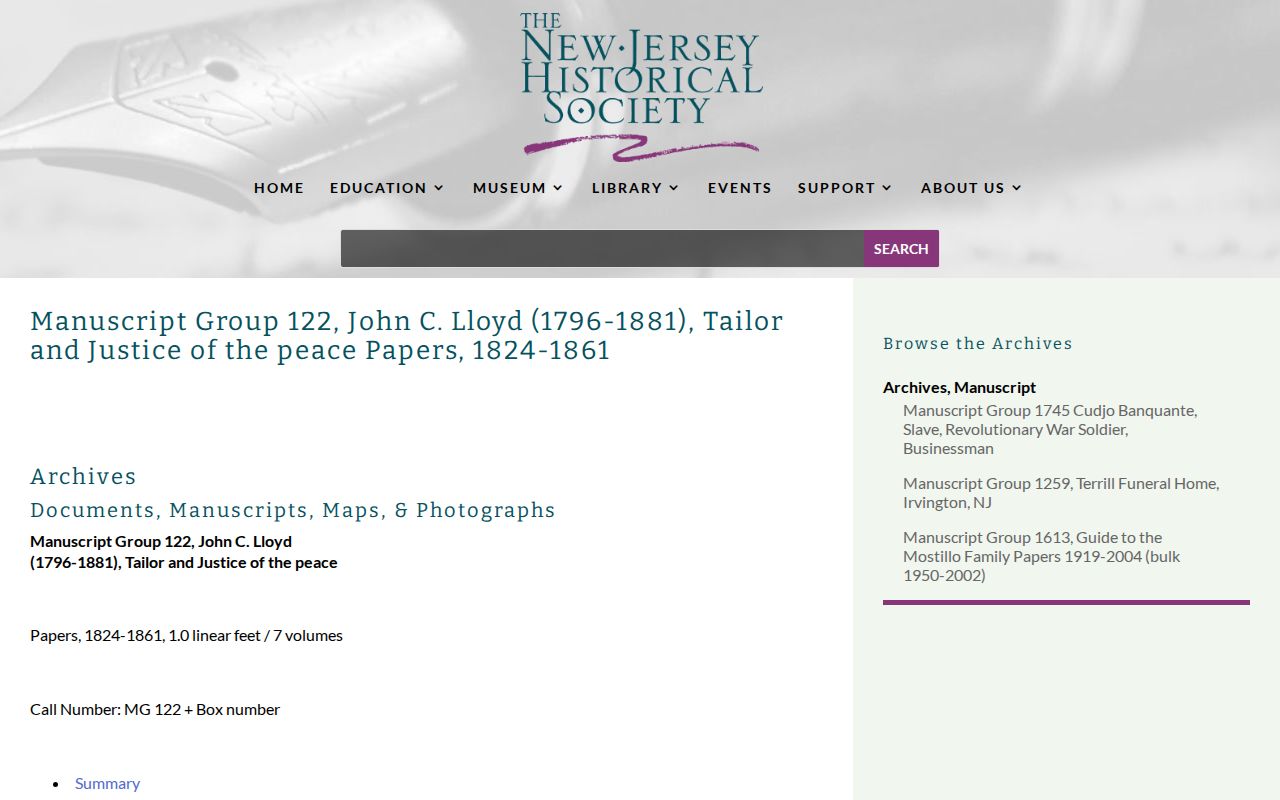
These unindexed volumes can add a dated Belleville person or transaction lead, but they should be cited by the source detail rather than treated as proof of residence.